








Walk-In Freezer Safety Requirements: An Ontario Checklist
Walk-in freezer safety requirements in Ontario: OHSA and Reg. 851 duties, the inside release (a New Brunswick worker was trapped 3 hours), floors and 313A.
Walk-in freezer safety requirements in Ontario do not come from a single rulebook. They come from the province’s workplace law, the licensing rules for the people who service the refrigeration, and federal rules for the panels, doors and refrigerants.
This guide pulls them into one place: the door, the floor, the lights, the cold, the refrigeration and who may touch it. It is written from the freezers we build and service across Ontario.
Key takeaways
- General employer duties: Ontario’s Occupational Health and Safety Act requires employers to keep equipment in good condition and take every precaution reasonable in the circumstances. Those duties apply inside the freezer too.
- The inside release: we found no Ontario regulation that names a walk-in inside release, but a New Brunswick worker trapped for three hours in a restaurant freezer shows why it matters. Every Coldmatic swing door we install has an interior safety release.
- Ice-free floors: Ontario’s Regulation 851 requires floors used by workers in industrial establishments to be kept free of hazards and accumulations of ice.
- Planned cold work: the Canadian Centre for Occupational Health and Safety says air speed in refrigerated rooms should not exceed 1 metre per second, and recommends layers and a buddy system.
- Licensed refrigeration work: 313A is a compulsory trade held by individual mechanics, and handling HFC and other halocarbon refrigerants needs a separate Ontario certificate.
What does Ontario law require for a walk-in freezer?
In Ontario, walk-in freezer safety rests on the Occupational Health and Safety Act and, for factories, shops and offices, Regulation 851 for Industrial Establishments. Neither one mentions walk-ins by name. Both set duties that apply to the box as a workplace, while other bodies regulate the equipment itself.
What the two set out:
- Equipment in good condition: section 25 of the Act requires an employer to ensure that the equipment and protective devices it provides are maintained in good condition. On a freezer, that would include the door hardware and the inside release.
- Every reasonable precaution: the same section requires the employer to provide information, instruction and supervision, and to take every precaution reasonable in the circumstances for the protection of a worker.
- Who Regulation 851 covers: it applies to industrial establishments, which the Act defines as an office building, factory, arena, shop or office. A shop is any place where goods are handled, exposed or offered for sale, or where services are offered for sale.
- 18°C minimum exempted: Regulation 851 sets a minimum of 18°C for an enclosed workplace, but section 129 exempts areas where perishable goods requiring lower temperatures are processed or stored.
- Usually not confined: Ontario’s confined spaces guideline lists walk-in freezers and refrigerators as examples of spaces designed and constructed for continuous human occupancy.
If you look for US OSHA rules on walk-in freezers, note that they do not apply here. Ontario workplaces answer to the Ontario Act, enforced by the Ministry of Labour.
Who regulates what on a walk-in freezer
| Area | Rule or body | What it covers |
|---|---|---|
| People working in the box | Occupational Health and Safety Act, Regulation 851 | General duties, floors, lighting, information and training |
| Refrigeration work | Skilled Trades Ontario (313A), O. Reg. 463/10 | Who may service the system and handle refrigerant |
| Electrical work | Electrical Safety Authority | Door heaters, lights, alarms and door operators |
| Refrigeration plants | TSSA, CSA B52 | Mechanical refrigeration code; registration for most plants above 22 kW |
| Panels, doors and refrigeration systems | Natural Resources Canada | Insulation and efficiency minimums |
| Refrigerant type | Federal halocarbon regulations | Global warming potential limits on new systems |
Getting out: the inside safety release
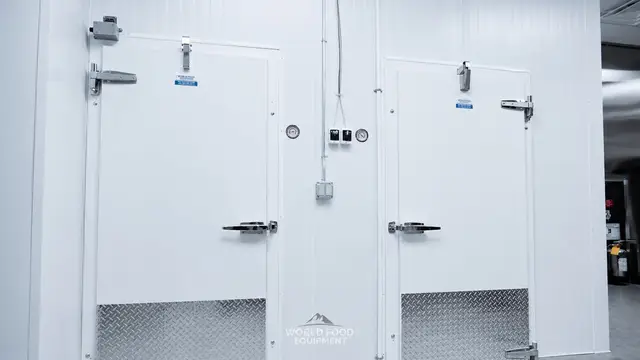
Being shut inside is one of the most serious walk-in freezer hazards. A walk-in door latches shut behind you, so if nobody is nearby, the inside release is the only way out. Keeping it working is a basic safety habit on any freezer.
A New Brunswick case, written up in a WorkSafeNB hazard alert, shows how it fails. An employee working alone at a restaurant went into a walk-in freezer, could not move the “mushroom cap” release when the door closed, and was found unconscious three hours later with hypothermia and frostbite.
The push rod was surrounded by ice. Staff usually kept the door open while working inside, so they rarely used the release, and dripping water had probably been freezing inside the handle for weeks or months.
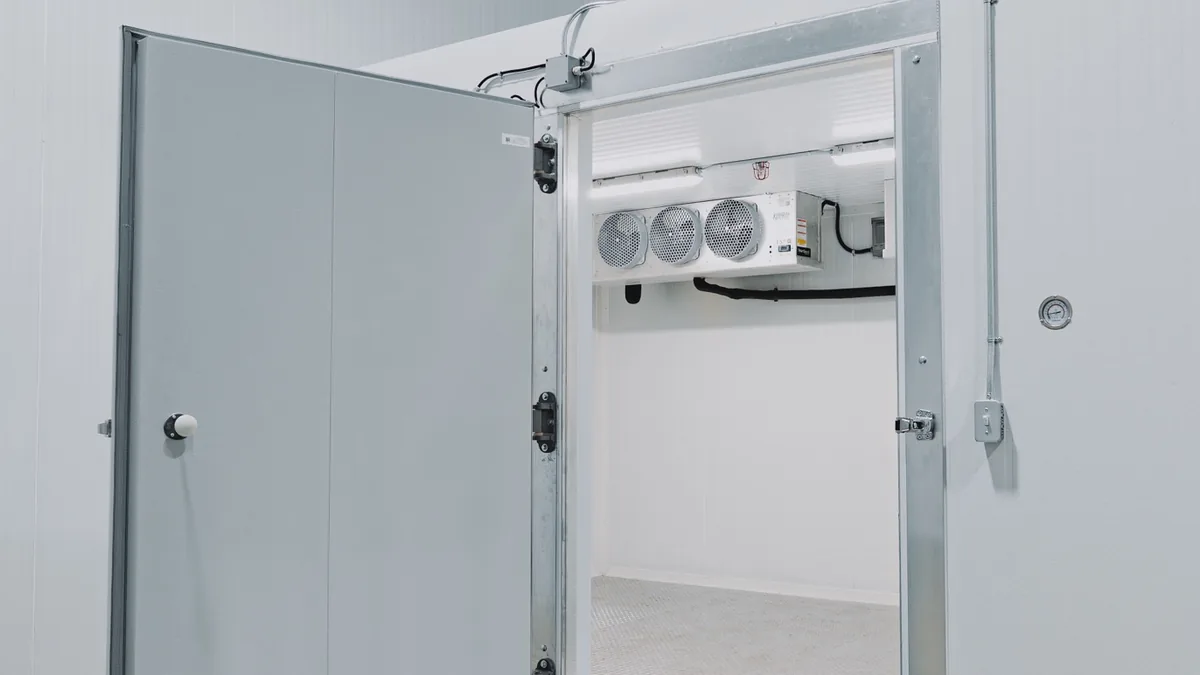
What keeps the release working, from that alert and from how we build our walk-in freezers:
- Press it regularly: WorkSafeNB says to inspect and depress the release regularly to avoid ice build-up, as part of your regular safety inspections.
- Free movement: the same alert says to make sure the cap moves in and out easily at all times.
- Train the crew: staff should know how the release works and how to break the ice if it will not move. The alert says a worker may need to kick the cap several times or hit it with a heavy object.
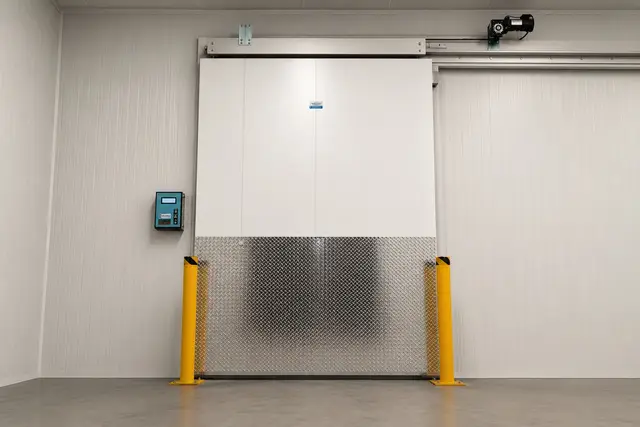
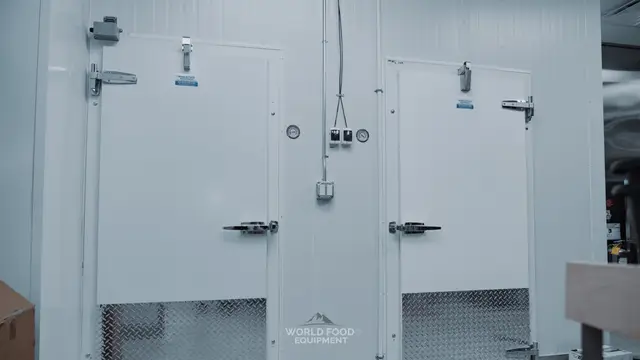
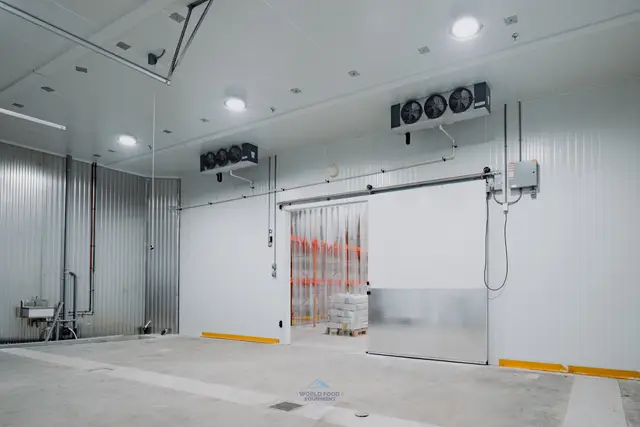
- Heated frame and threshold: our freezer doors get a heated perimeter frame and threshold so the gasket does not freeze to the jamb. A dead frame heater is a repair call, not something to work around.
- Standard on our doors: every Coldmatic swing door we install has an interior safety release on Kason hardware. Our walk-in door guide covers the rest of the hardware.
- Check before you lock: walk the box before locking it at close, and confirm with your door supplier that the inside release still opens the door when the latch is locked.
Two other provinces put it in writing. Alberta’s OHS Code, section 120 requires a door to an enclosed area that poses a hazard to have a means of opening it from the inside at all times. British Columbia’s agriculture rules require cold storage rooms on farms to have at least one door that can always be opened from inside.
Alarms and working alone in the freezer
We found no Ontario rule that requires an alarm in a walk-in freezer. Two kinds are worth planning for: alarms that protect the product and alarms that protect the person. WorkSafeNB recommends a working-alone code of practice that includes provisions for an alarm should an employee become trapped in the freezer.
- High-temperature alarms: our commercial electrical crew wires high-temperature alarms with a dry contact for your monitoring system.
- Door-open alarms: an alarm that sounds when a freezer door is left open.
- Trapped-worker alarms: an alarm or call button inside the box that someone outside will hear. Raise it when you spec the freezer, so the wiring goes in with the build.
- Check-in procedures: WorkSafeNB lists procedures for checking on a person working alone and emergency procedures for someone trapped inside.
- The buddy system: CCOHS recommends a buddy system so workers can look out for one another in the cold.
Floors, ice and slips
Ice and wet floors are the everyday walk-in freezer hazard. Section 11 of Regulation 851 requires any floor or surface used by a worker to be kept free of obstructions, hazards and accumulations of ice, and bans finishes likely to make it slippery. In a freezer, that starts with stopping ice from forming.
- Ice at the door: most floor ice in a freezer comes from warm, moist air getting in at a door that does not seal. Our freezer ice build-up guide covers the causes and the fixes.
- Heated threshold: the heated sill on a freezer door keeps the threshold from icing over where people step in and out.
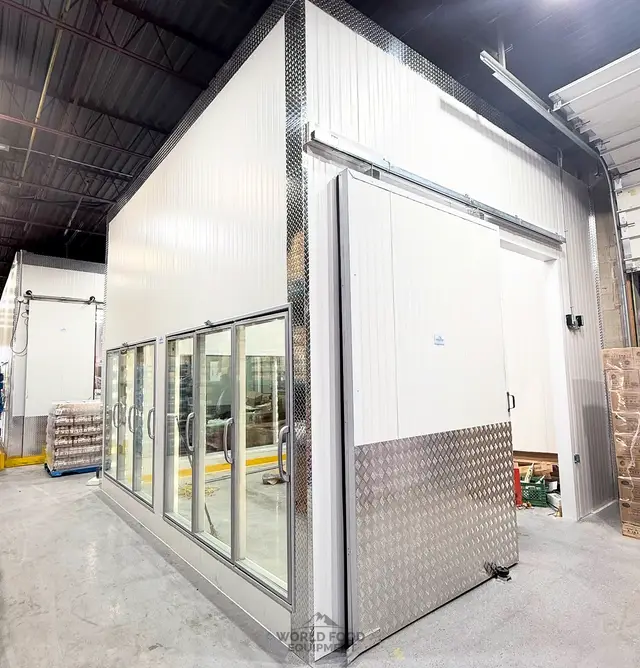
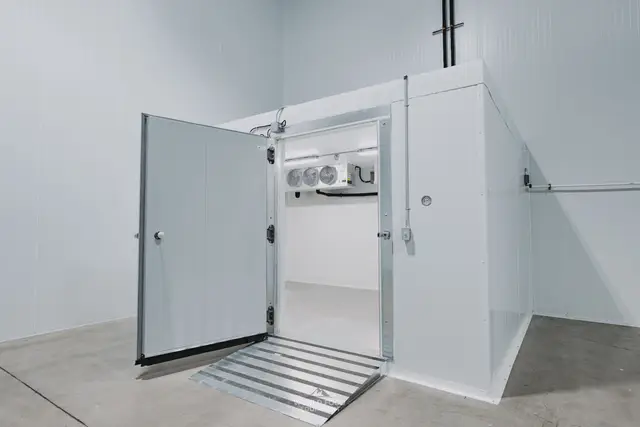
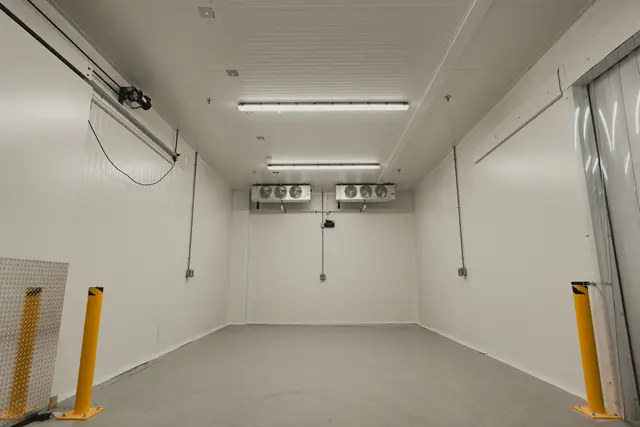
- Floor finish: we finish freezer floors in aluminum tread or chequer plate, with a ramp at the door where the box sits on an insulated floor.
- Spill cleanup: CCOHS fall prevention guidance calls for cleaning all spills immediately and marking spills and wet areas.
- Proper footwear: on floors that may be wet, the same guidance says fall prevention should focus on selecting proper footwear.
- Clear walkways: boxes and pallets left in the aisle can count as obstructions under section 11.
Lighting inside a walk-in freezer
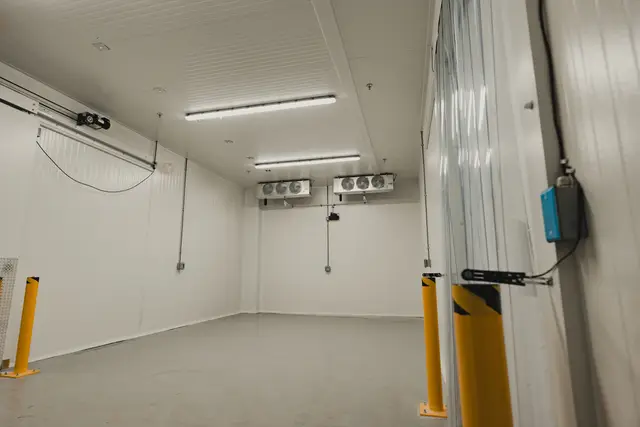
Section 21 of Regulation 851 requires artificial lighting wherever natural light is not enough to keep workers safe, with shadows and glare kept to a minimum. A walk-in freezer has no natural light. The fixtures are the only light in the room, so they have to start and run reliably at freezer temperature.
- Cold-rated fixtures: we install vapour-proof LED fixtures rated for the box temperature.
- Light the way out: the floor at the door and the inside release should sit in good light, not in the shadow of a rack.
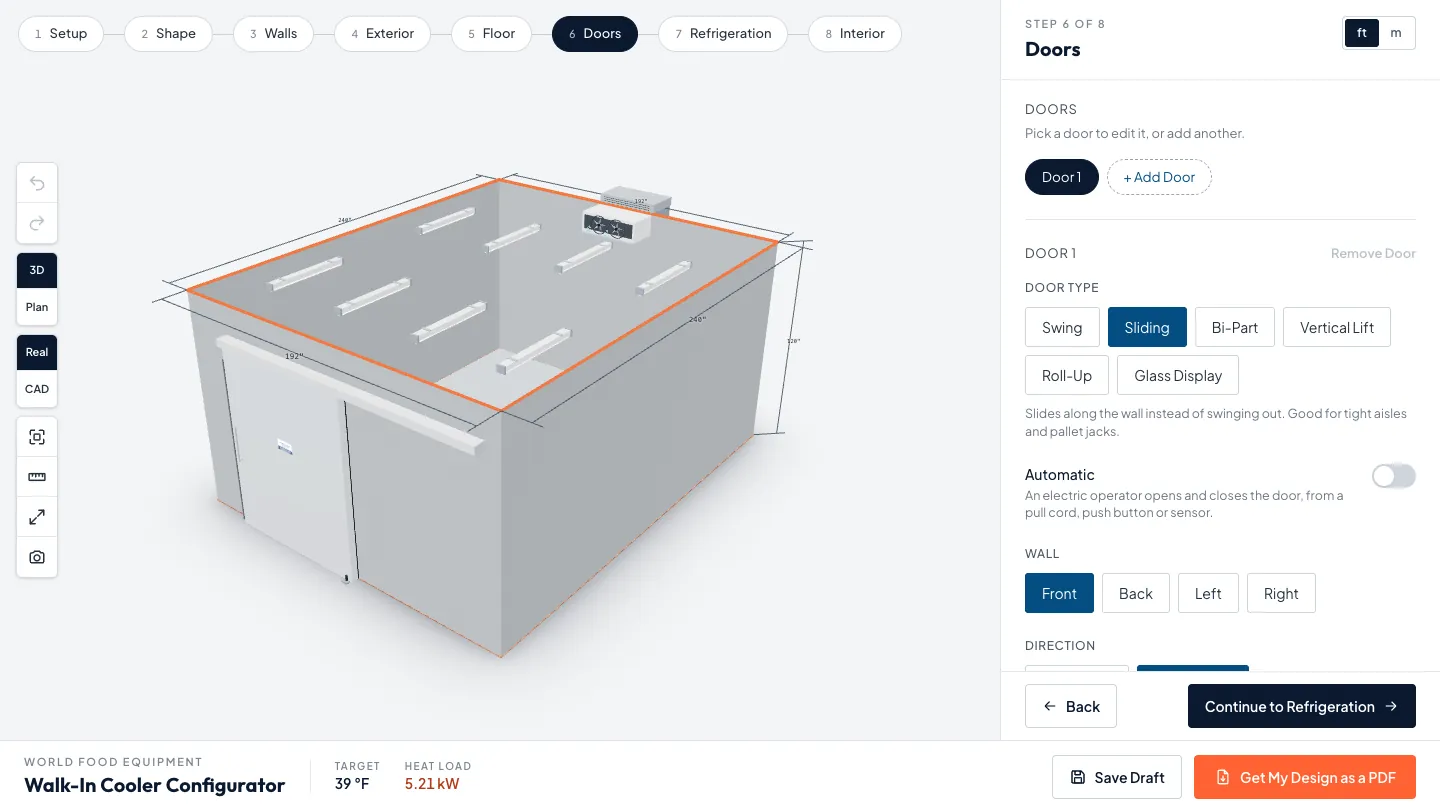
- Plan the layout: the Interior step of our 3D design tool lets you place LED fixtures before anything is built.
Cold exposure for the people inside
We found no Ontario rule that limits time in a walk-in freezer, and the 18°C minimum does not apply to cold storage. The general duty still does: the employer has to acquaint workers with the hazards of the work and provide information, instruction and supervision. The CCOHS guidance on cold environments is the practical reference.
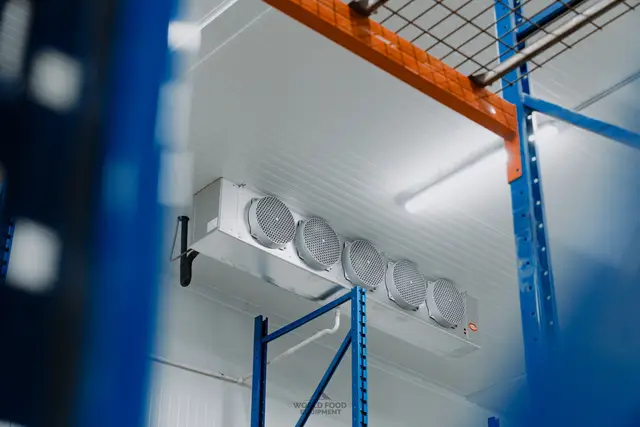
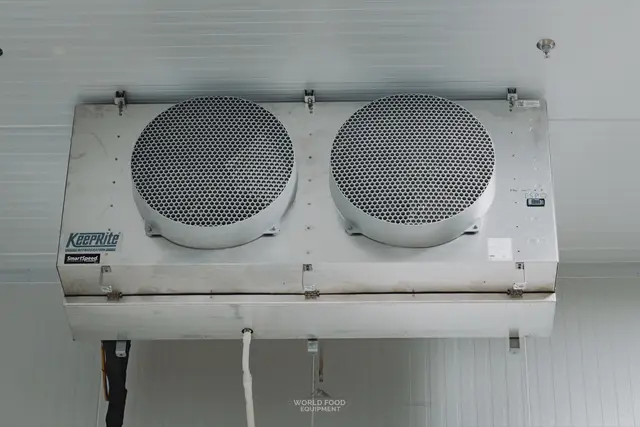
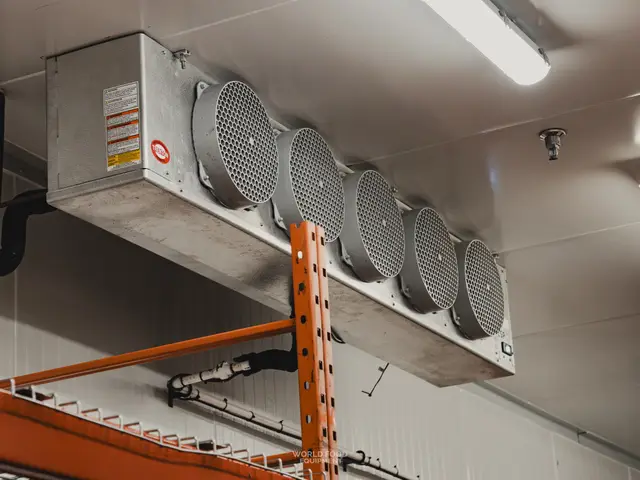
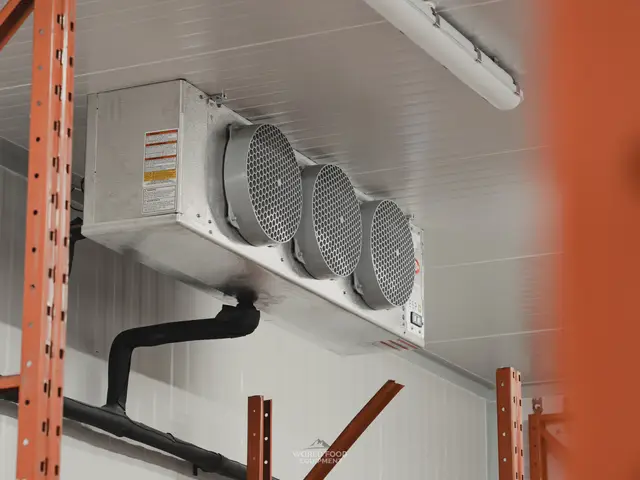
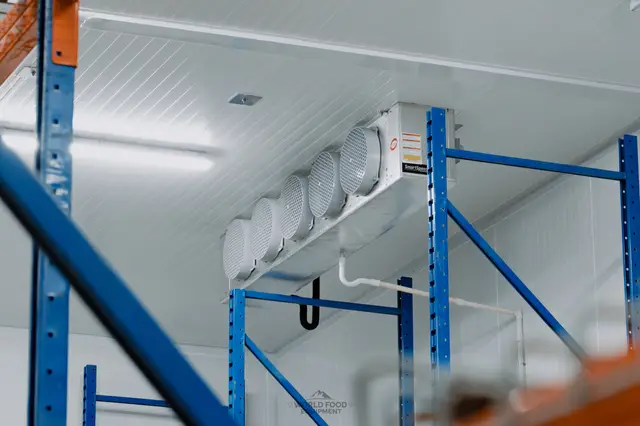
- Draft limit: CCOHS says air speed in refrigerated rooms should not exceed 1 metre per second. Evaporators should not blow straight at the spots where people stand and pick.
- Layered clothing: CCOHS advises dressing in layers rather than one heavy garment. Clothing soaked with sweat loses much of its insulation value.
- Hands, head and feet: where fine finger work is not needed, CCOHS says mittens should be used below minus 17°C, with a hat suited to the conditions and insulated footwear.
- A warm place nearby: CCOHS recommends heated warming areas close to cold work.
- What cold does: CCOHS lists hypothermia and frostbite among the injuries from cold, with hypothermia the most severe.
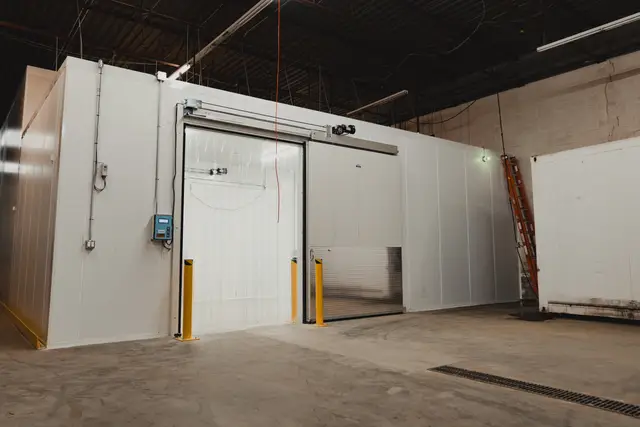
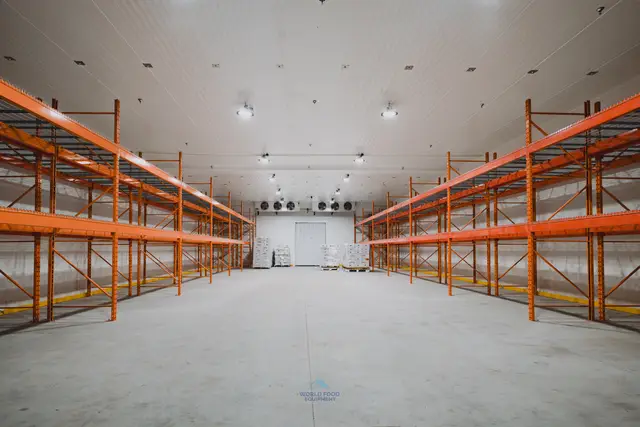
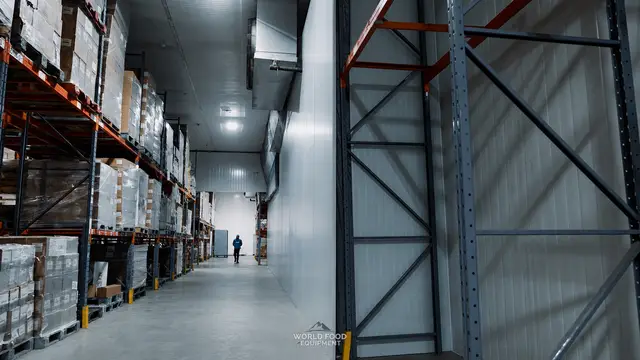
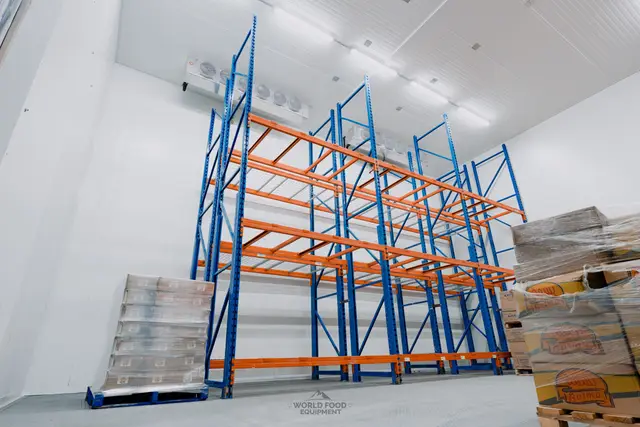
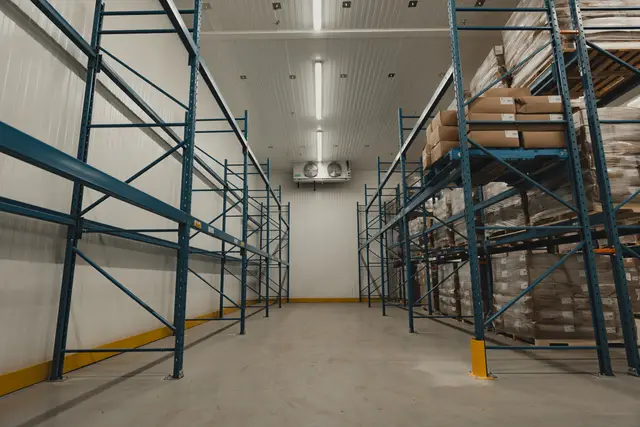
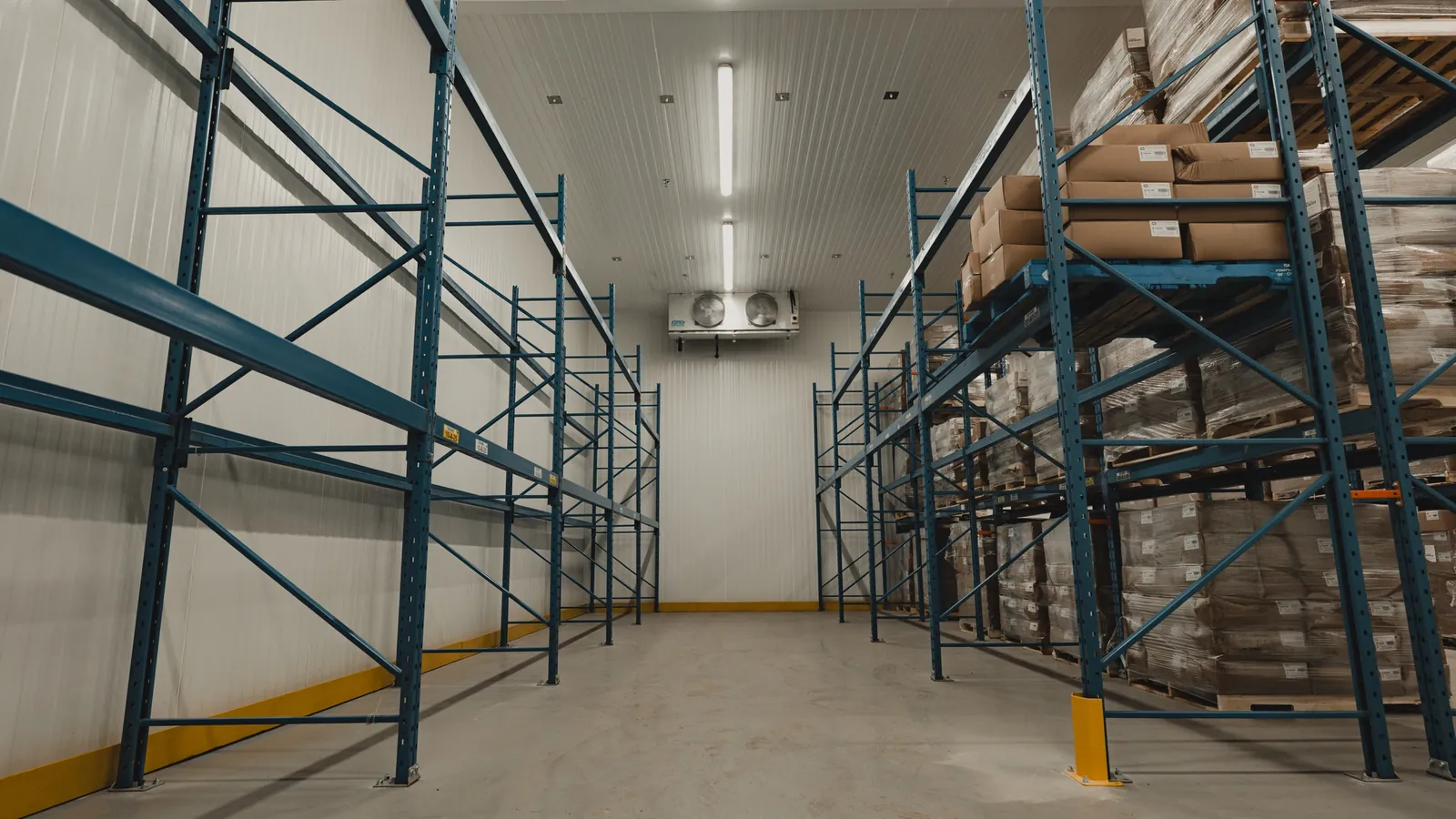
People in large racked freezers work in the cold for hours at a time. Our industrial walk-in freezer guide covers how we plan those rooms around the crew as well as the product.
Who can work on walk-in freezer refrigeration in Ontario?
The refrigeration side of a walk-in freezer is licensed work in Ontario. Refrigeration and air conditioning systems mechanic (313A) is a compulsory trade, so the person doing the work needs a certificate of qualification, a provisional certificate or a registered training agreement. Handling HFC and other halocarbon refrigerants needs a second, separate certificate.
- 313A is personal: the certificate is issued to the mechanic who passes the exam, not to a company. Our 313A-licensed technicians each hold their own.
- Refrigerant certificate: Ontario says only a certified technician can remove, discharge, handle and dispose of HFC and other halocarbon refrigerants. It does not cover hydrocarbon refrigerants.
- Card alone not enough: the same page says you cannot work on or fix refrigeration equipment with only that certificate card.
- Leak tags: under O. Reg. 463/10, a technician who tests the equipment for leaks attaches a notice to it. If there is a leak, the notice states that no refrigerant may be added until the leak is repaired.
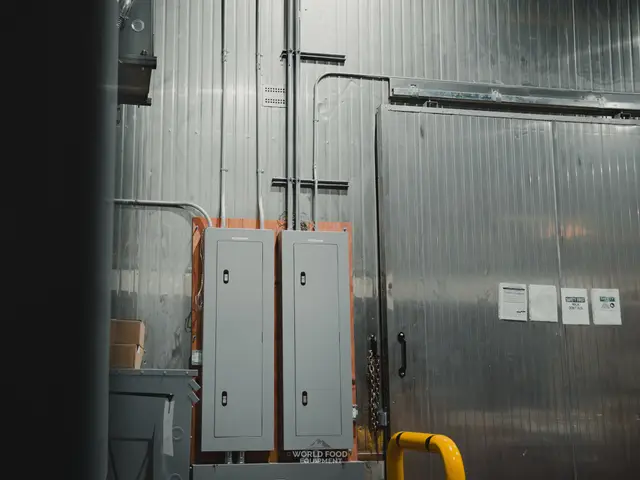
- Electrical work: door heaters, lights, alarms and door operators are electrical work, and ESA says whoever does the electrical work must file the notification of work.
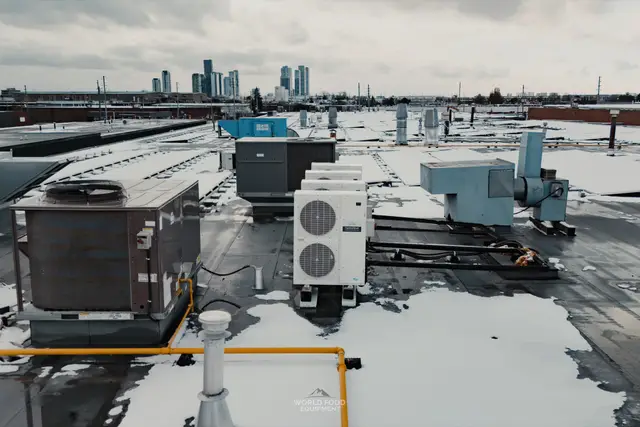
- Plant registration: TSSA says most refrigeration plants with compressors over 22 kW must be registered.
- The refrigeration code: TSSA’s code adoption document brings CSA B52, the Mechanical Refrigeration Code, into Ontario regulation, with the 2023 edition (Update 1) in effect since August 1, 2025.
Our installer licensing checklist goes deeper on permits and trades. WFE repairs walk-in freezers of any brand; book a technician through walk-in cooler and freezer repair.
Refrigerant safety in and around the box
A refrigerant leak is mostly an equipment problem, but in a closed room it is also a people problem. Transport Canada’s CANUTEC says the main hazard of non-flammable refrigerants is asphyxiation, because an uncontrolled release can displace the oxygen in the air. Flammable refrigerants add a fire risk.
From CANUTEC’s refrigerant hazard guide:
- Warning signs: symptoms of asphyxiation include dizziness, weakness, nausea and loss of coordination.
- Flammable refrigerants: propane (R290) and isobutane (R-600a) are effective refrigerants but fire hazards. They tend to stay close to the ground and can collect in low spots.
- Charge limits: designers usually limit the amount of a flammable refrigerant in a system to reduce the risk.
- First response: for inhalation, CANUTEC says to move to fresh air immediately and seek medical attention.
If you suspect a leak, get people out of the box and call a 313A technician; refrigerant lines are not owner work. New systems also face refrigerant limits: since January 1, 2020, condensing units and centralized systems cannot be made or imported with an HFC above a global warming potential of 2,200.
The federal rules for the box itself
Walk-in freezers are regulated in Canada, but the federal rules target energy efficiency rather than worker safety. A box that meets them, with the right door hardware, is also easier to keep free of ice and safe to work in.
From Natural Resources Canada’s walk-in components page:
- Panels and doors: components made on or after June 5, 2017 must meet insulation minimums, RSI 5.64 (R-32) for freezer wall and ceiling panels and passage or freight doors, and RSI 4.93 (R-28) for freezer floor panels.
- Refrigeration systems: NRCan’s refrigeration system requirements phased in from January 1, 2020 for cooler condensing systems and July 10, 2020 for freezer condensing systems and unit coolers.
- Panel fire data: the Norbec and Kingspan panels we install carry CAN/ULC-S102 surface-burning results; our insulated panels page lists the fire testing.
Our panel R-value guide explains the insulation numbers.
Walk-in freezer safety checklist
Use this as a walk-through for an existing freezer or a spec list for a new one. The rule or source for each line is in the sections above.
| Check | What good looks like | Who |
|---|---|---|
| Inside release | Moves in and out freely, no ice around the push rod | Staff check; technician repairs |
| Door, gasket and frame heater | Door closes and seals, no ice at the gasket or sill | Staff check; technician repairs |
| Floor | No ice, spills or boxes in the walkway | Staff |
| Lighting | Every fixture works; the door and release are well lit | Staff check; electrician repairs |
| Alarms | Product, door and trapped-worker alarms sound where someone will hear them | Staff test; electrician repairs |
| Working alone | A check-in plan, and someone knows who is inside | Supervisor |
| Clothing | Layers, mittens or gloves, a hat and insulated boots | Employer and worker |
| Refrigeration | Holds temperature; the last leak-test notice is on the unit | 313A technician |
On freezers we built, our preventive maintenance visits test the door and gasket and check the closer, hinges and latch. For setpoints and food-safety temperatures, see our walk-in freezer temperature guide.
Frequently asked questions
What are the safety requirements for a walk-in freezer in Ontario?
Ontario has no regulation written for walk-ins alone. The Occupational Health and Safety Act requires employers to keep equipment in good condition and take every reasonable precaution, and Regulation 851 requires workplace floors free of ice and hazards and adequate lighting. Refrigeration work needs a 313A mechanic, and handling halocarbon refrigerants needs a provincial certificate.
Can you get locked in a walk-in freezer?
Yes, if the inside release fails. A WorkSafeNB hazard alert from New Brunswick describes a restaurant worker found unconscious after three hours in a walk-in freezer because ice had formed around the release push rod. Press the release regularly and keep it free of ice.
Do OSHA walk-in freezer regulations apply in Ontario?
No. OSHA is a United States federal agency. In Ontario, walk-in freezer safety at work falls under the provincial Occupational Health and Safety Act and its regulations, including Regulation 851 for industrial establishments.
Is a walk-in freezer a confined space in Ontario?
Generally not. The Ontario guideline on confined spaces lists walk-in freezers and refrigerators as examples of spaces designed and constructed for continuous human occupancy. The general duties on doors, floors and lighting still apply.
What should workers wear in a walk-in freezer?
CCOHS recommends several layers rather than one thick garment, mittens below minus 17°C where fine finger work is not needed, a hat and insulated footwear. Clothing that gets wet from sweat loses much of its insulation value, so dry layers matter on long shifts.
Is an alarm required in a walk-in freezer in Ontario?
We found no Ontario rule that requires one. WorkSafeNB recommends a working-alone code of practice with provisions for an alarm should a worker become trapped in the freezer. Plan any trapped-worker, door-open or high-temperature alarm when you spec the freezer, so the wiring goes in with the build.
Plan Your Build
Size your walk-in in the configurator.
Set dimensions, doors, and refrigeration in 3D, then download the spec sheet to share.
Read Next
Plan a Walk-In Cooler or Freezer in 3D: 8 Decisions
The eight decisions that shape every walk-in cooler or freezer, and where to make each one in our free 3D configurator: size, type, panels, floor, doors, refrigeration, racking and lights.
Industrial Walk-In Freezers: What to Plan Before You Build
What changes when a walk-in freezer gets big enough for pallets and forklifts: the slab, the clear height, the doors, the refrigeration plant, and the Ontario rules that start to apply.
Walk-In Cooler & Freezer Doors: Types, Sizes, Options
Swing, sliding, pallet and roll-up doors for walk-in coolers and freezers: which one fits your traffic, the sizes we build to, what a freezer door adds, and the Canadian rule every walk-in door has to meet.
Walk-In Coolers — Custom Builds
See the service page for sizing, anatomy, and what's included in a WFE install.